
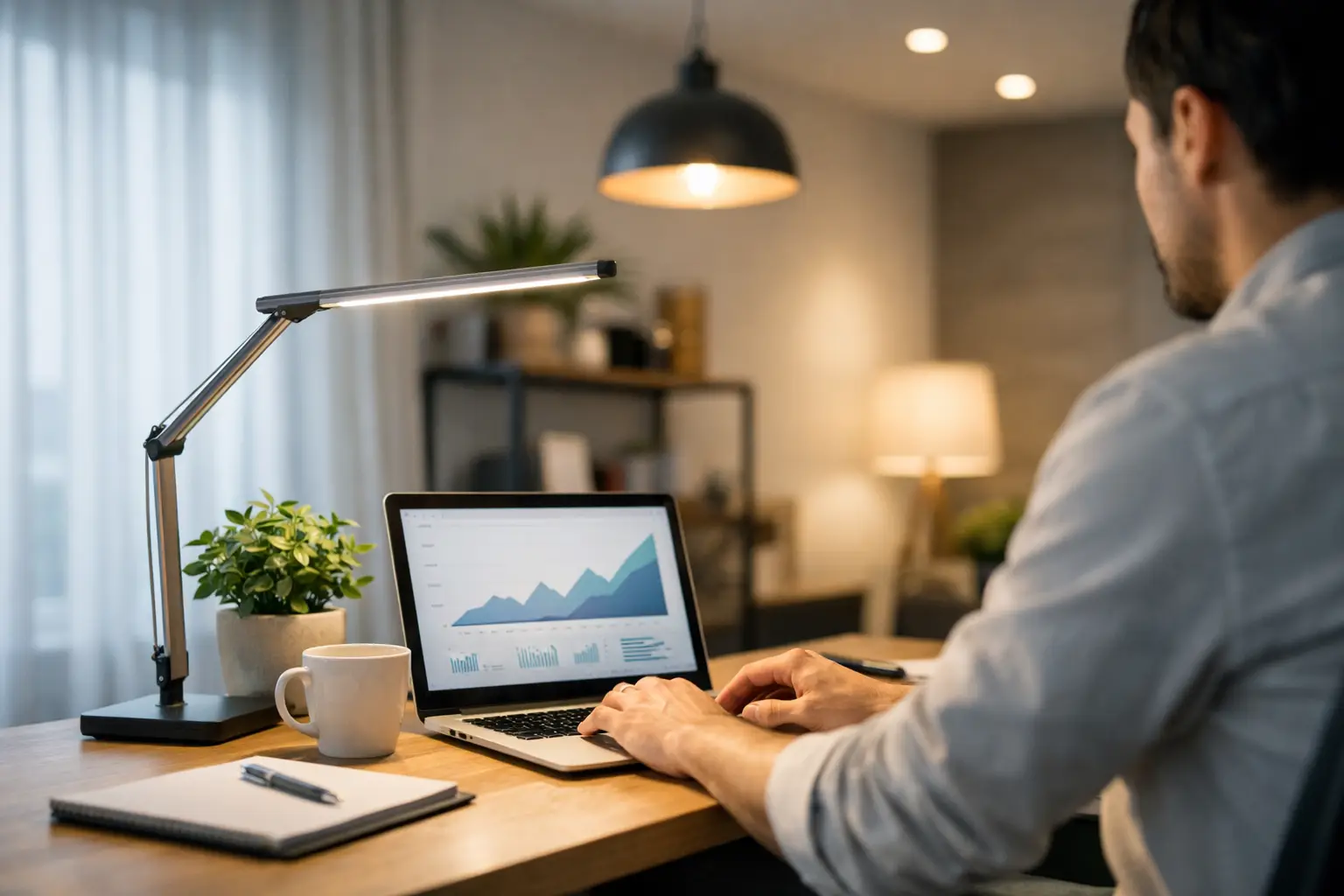
Indoor Lighting for Productivity That Works
This article contains affiliate links. If you buy through them I may earn a small commission at no extra cost to you.
By 3pm, a lot of people assume their brain has given up. Often, the problem is less dramatic than that. If you are working under dim ceiling lights, staring at a bright screen in a gloomy room, or sitting in warm yellow light all day, your environment may be making concentration harder than it needs to be. Good indoor lighting for productivity is not about turning your home into a laboratory. It is about giving your eyes and brain better signals so you can stay alert in the day and wind down properly later.
Light affects more than what you can see. It also influences alertness, mood, timing of sleep and how much strain your eyes are under. That matters if you work from home, spend long hours at a desk, or regularly feel foggy by late morning. The right setup can help, but there is no single perfect bulb for everyone. The best approach depends on the room, the time of day and the kind of work you are doing.
Why indoor lighting for productivity matters
Your body responds to light as a timing cue. Bright light, especially earlier in the day, helps signal that it is time to be awake and alert. Lower and warmer light in the evening supports the shift towards rest. When indoor lighting stays too dim during working hours or too harsh at night, those signals get blurred.
This is one reason people can feel oddly tired indoors even after a full night’s sleep. A dark room encourages drowsiness. Harsh glare, on the other hand, can leave you tense and visually fatigued. Neither helps sustained concentration.
There is also a practical side. Poor lighting makes reading, typing and screen work more effortful. You squint more, posture worsens, and headaches become more likely. That does not mean lighting alone will fix low energy. If you are sleeping badly, skipping meals or barely moving all day, those issues still matter. But lighting is one of the easier changes to make, and many people overlook it.
Start with daylight, then build around it
If there is one principle worth keeping, it is this: use natural light whenever you can. Daylight tends to be brighter and more useful for daytime alertness than typical indoor lighting. If you work near a window, make the most of it.
Position your desk so daylight comes from the side rather than directly behind your screen or straight into your eyes. Side lighting usually gives the best balance. It reduces reflections while keeping the room brighter overall. If the window is in front of you and causing glare, a sheer blind can soften it without blocking all the light.
That said, daylight is not always enough. British weather is not known for consistency, and many homes have one overhead fitting doing too much work. So the real goal is to support daylight, not rely on it completely.
The best lighting setup is layered, not brighter everywhere
One common mistake is trying to solve everything with a stronger ceiling bulb. That can make a room feel flat and uncomfortable. A better approach is layered lighting. In plain terms, that means using more than one source of light for different jobs.
Ambient lighting gives the room its general brightness. Task lighting supports specific activities such as reading, writing or computer work. Accent lighting is less important for productivity, but it can make a room feel less stark and help reduce the cave-like effect of a single overhead light.
For most home offices or study areas, a decent combination is a well-lit room plus a desk lamp. That gives you enough overall brightness to stay alert, while allowing focused light where you need it. If the room is bright but your desk surface is still gloomy, you will feel the strain. If the desk is very bright but the rest of the room is dark, contrast becomes tiring. Balance matters more than brute force.
Brightness and colour temperature matter more than trends
When people search for better indoor lighting for productivity, they often get lost in technical language. You do not need to become an expert in lighting design, but two terms are worth understanding: brightness and colour temperature.
Brightness is measured in lumens. More lumens generally means more light, though the size of the room and the shade on the lamp affect how that light feels. If your workspace feels gloomy even in the middle of the day, you probably need more usable light, not a more expensive bulb.
Colour temperature describes whether light looks warmer or cooler. Warm light has a softer yellow tone. Cooler light looks whiter or slightly blue. During the day, cooler or neutral white light often helps with alertness and visual clarity, especially for desk work. In the evening, warmer light is usually the better choice because it feels less stimulating.
For many people, a neutral to cool white desk lamp works well for focused daytime tasks, while warmer lighting suits living rooms and bedrooms later on. The trade-off is comfort. Some cooler bulbs can feel clinical in a home setting, particularly if they are too bright or poorly diffused. If a light makes your room feel harsh, you are less likely to use it properly.
How to light a home workspace without making it miserable
A productive workspace should feel clear, not glaring. Start with the main source of room light. If your overhead fitting is weak, replace the bulb with something brighter but still pleasant to live with. Then add a desk lamp that lights the working area without shining directly into your eyes.
If you write by hand, read paper documents or do detailed tasks, task lighting becomes even more useful. Place the lamp to the side of your dominant hand so it does not cast shadows across the page. For screen work, angle the lamp away from the monitor to avoid reflections.
Pay attention to contrast. A very bright screen in a dark room is a common recipe for eye strain. It feels manageable for an hour, then suddenly you have a headache and your concentration drops. It helps to keep the room moderately lit so the screen is not the only bright object in sight.
If you join lots of video calls, front lighting is also worth considering. It does not need to be studio-level. A soft light in front of you, slightly above eye level, usually looks better and feels easier than a harsh ceiling light casting shadows down your face.
Lighting mistakes that can drain energy
Some lighting problems are easy to miss because they become normal. One is relying on a single warm lamp in a dark room during the day. It can feel cosy, but cosy is not always productive. Another is using very bright cool light late into the evening, then wondering why sleep feels delayed.
Glare is another issue. Bare bulbs, shiny desks and poor screen positioning can all create visual stress. If you catch yourself squinting, shifting position constantly or feeling relief when you leave the room, the setup probably needs adjusting.
Flicker can matter too, even when it is subtle. Some cheaper bulbs create a low-level flicker that contributes to discomfort or fatigue in sensitive people. If a new bulb leaves you feeling oddly strained, the problem may not be your imagination.
Match your lighting to the time of day
The most useful lighting setup changes with your routine. In the morning, brighter light helps tell your body the day has started. If natural daylight is limited, especially in winter, brighter indoor light can support that transition.
Through the working day, aim for a space that feels bright enough to read, think and focus comfortably. Late afternoon may call for a slight adjustment if outside light drops. Then in the evening, it makes sense to shift towards lower, warmer light, especially in the hour or two before bed.
This matters because productivity is not only about squeezing out more work. If your daytime lighting keeps you alert but your evening lighting wrecks your sleep, you lose the benefit the next day. Energy, focus and rest are linked.
What is worth buying, and what is not
You do not need a complicated smart home system to improve your lighting. For most people, the biggest gains come from three simple upgrades: a brighter main bulb where needed, a good desk lamp, and bulbs with suitable colour temperature for the room and time of day.
Adjustable lamps are useful because they let you direct light where you need it. Dimmable bulbs can help if one room serves different functions, such as a spare room that acts as an office by day and a bedroom by night. Smart bulbs can be convenient, especially for evening routines, but they are optional rather than essential.
If budget is tight, fix the worst problem first. Usually that means the room where you spend the most working hours. One well-chosen lamp can do more for comfort and focus than several fashionable lighting accessories.
Guidance from bodies such as the NHS, the Sleep Foundation and the Chartered Institution of Building Services Engineers supports the broader point that light exposure influences alertness, sleep timing and comfort indoors. You do not need perfect conditions. You just need better signals than the ones many homes currently provide.
A useful rule is this: if your room makes you feel sleepy at noon or wired at 10pm, the lighting is probably working against you. Small changes are often enough. Brighter in the day, softer at night, less glare throughout – no hype, just simple habits that work.
A few specific options worth looking at
A daylight desk lamp
If your desk lighting is the main problem, a daylight LED desk lamp with adjustable colour temperature solves most of the issue in one go. Look for one that lets you switch between cooler white for daytime work and warmer tones for evening use, rather than buying two separate lamps. An adjustable arm is also worth having so you can angle the light away from your screen and avoid glare.
A brighter, dimmable main bulb
For the main room light, a dimmable daylight LED bulb gives you the flexibility the article talks about, bright and cool during the day, dimmed and warmer in the evening, without needing to change the bulb itself. A standard E27 or E14 fitting bulb with a dimmer-compatible label is enough. You do not need anything smart for this to work well.
A smart bulb, if you want the convenience
If you would rather not get up and adjust a dial throughout the day, a smart bulb such as the Philips Hue White Ambiance lets you set a cooler white in the morning and have it shift automatically to a warmer tone in the evening. It is genuinely useful for this specific purpose, though as the article says, it is optional rather than essential. A simple dimmer switch does most of the same job for a fraction of the price.
For video calls
A small ring light or soft panel light placed in front of you, slightly above eye level, makes a noticeable difference on video calls without needing anything studio-level. Most desk-clamp versions are inexpensive and pack away easily when not in use.
None of this needs to be expensive or complicated. Fixing the room where you spend the most working hours, with one decent lamp and a sensible bulb, usually does more good than several smaller changes spread across the house.
Further Reading
If you enjoyed this article you might like to read these articles.
- Morning Light Exposure Guide for Better Energy
- The Real Guide to Daily Energy
- Morning Sunlight Benefits for Energy and Sleep
The role of wellness products

Some people explore supplements or wellness products to support their daily routines. While these can sometimes be helpful, they should be viewed as support rather than a replacement for healthy habits.
If you are interested in exploring wellness products that may support energy routines, you can browse the options available at the Wellthy Freedom Hub store.
Always read ingredient labels carefully and speak with a healthcare professional if you have medical conditions or take medication.
Disclosure: This site may link to products on wellthyfreedomhub.com. If you choose to buy, the store benefits. The guidance here is informational and not medical advice.

Richard Chambers is the founder of rrjchambers.com. He writes about practical ways to improve everyday health, energy, and wellbeing through simple routines, lifestyle habits, and carefully chosen wellness products. His focus is on clear, honest guidance that helps people make small changes that support better health over time.
Health Information Notice
The information in this article is intended for general educational purposes only and should not be considered medical advice. If you have concerns about your health, sleep, or energy levels, it is always best to consult a qualified healthcare professional.