
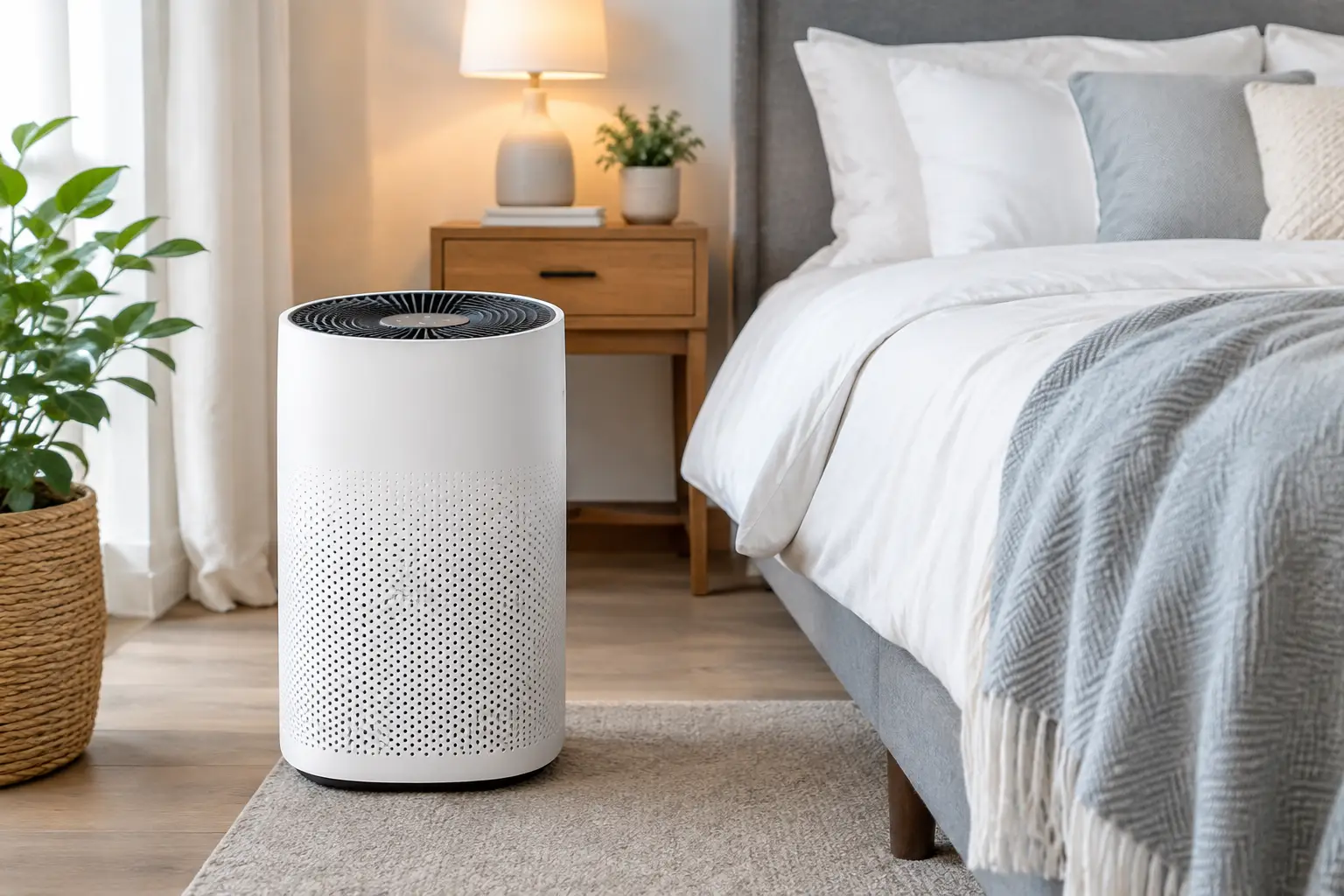
Bedroom Air Purifier Review: What Matters Most
A bedroom air purifier review should start with the thing that often gets missed: the best machine is not necessarily the one with the biggest claims. It is the one you can run consistently through the night, in a room of your actual size, without being kept awake by it. Cleaner air may help reduce exposure to airborne particles, but it is not a cure for poor sleep, ongoing tiredness or a stuffy bedroom caused by damp, overheating or an unwashed duvet.
For many people, an air purifier is a sensible supporting tool. It can be particularly useful if you live near a busy road, share your home with pets, notice dust settling quickly, or find pollen season affects your nights. The practical question is whether it will make enough difference to justify the cost, space and background noise.
Bedroom air purifier review: judge the basics first
Marketing tends to make every purifier look essential. Claims about “fresh” air, ion technology and multiple cleaning stages can distract from the few features that genuinely matter in a bedroom: the type of filter, the size of the room it can handle, how loudly it runs, and what it costs to keep going.
A good bedroom model should have a proper particle filter, ideally a HEPA filter or one clearly rated to capture fine particles. These filters are designed to trap dust, pollen, pet dander and other airborne particles. If allergies are part of the picture, this is usually more relevant than extra modes and coloured lights.
Many units also include an activated carbon filter. Carbon can help reduce some odours and gases, which may be useful in a bedroom affected by cooking smells, traffic fumes or pets. However, a thin carbon sheet will have limited impact. If odour removal is a main reason for buying, look for a model that states how much activated carbon it contains rather than relying on vague claims.
Be cautious around purifiers that deliberately produce ozone or make broad promises about eliminating every pollutant. Ozone can irritate the lungs, and no domestic purifier removes every indoor air issue. A machine can reduce particles in the air passing through it. It cannot clean bedding, solve mould behind a wardrobe, or replace ventilation where moisture is building up.
Match the purifier to your bedroom, not the box
Room-size figures can be misleading because manufacturers do not always test machines in the same way. One may quote the maximum area the unit can cover slowly; another may quote a smaller room where it changes the air several times per hour. For a bedroom, faster air cleaning is generally more useful than simply meeting the minimum claim.
Start by estimating your room. Multiply length by width to get the floor area in square metres. A typical box room might be 9 to 12 square metres, while a larger main bedroom may be 15 to 20 square metres or more. If ceilings are unusually high, the room contains an open doorway, or you keep the door open at night, treat it as a bigger space.
Then look for the clean air delivery rate, often shortened to CADR, where it is provided. A higher CADR generally means the purifier can filter more air in a given time. It is a more helpful figure than a broad statement such as “suitable for rooms up to 40 square metres”. If CADR is not given, choose a machine rated comfortably above your room size rather than exactly on the limit.
There is a useful rule of thumb here: buy enough capacity that the purifier can run at a low or medium setting overnight. A smaller unit pushed to maximum is likely to be louder, and it may be tempting to switch it off after a few nights. Consistency matters more than having an impressive top speed you never use.
Noise is not a minor detail
A purifier can be technically effective and still be a poor bedroom purchase if the sound annoys you. Fan noise varies considerably. Some people find a steady low hum soothing; others notice every change in speed. Do not assume a quoted “sleep mode” will be silent, either. It usually means the fan is slower and the display is dimmed.
Check the decibel rating for the lowest setting, but also consider reviews that describe the character of the noise. A smooth airflow sound is often easier to ignore than a high-pitched whine, rattle or intermittent clicking. If you are a light sleeper, place quiet operation above app controls, air-quality graphics and smart-home extras.
Lights matter too. A bright display can undermine a bedroom that is otherwise dark and calm. Choose a model with a proper display-off function, not merely a dim setting. Small disturbances add up when sleep is already inconsistent.
The running costs people forget to calculate
The purchase price is only one part of the decision. Filters need replacing, and replacement costs can turn an apparently cheap purifier into an expensive one over two or three years. Before buying, check the recommended replacement interval, the cost of genuine filters and whether they are straightforward to source in the UK.
Filter life depends on how hard the machine works and how dusty your home is. A purifier placed near an open window facing a main road may need attention sooner than one in a relatively clean, quiet room. Vacuuming the exterior pre-filter, if the design allows it, can help maintain airflow and extend the life of the main filter.
Electricity use is normally modest on a low setting, but it is still worth checking the wattage if the machine will run every night. A purifier that uses little power at the setting you actually use is more valuable than one that is efficient only in theory.
Avoid washable HEPA claims unless the manufacturer clearly explains what can and cannot be washed. Many true HEPA-style filters are not washable. Washing them can damage the filter material and reduce performance. A removable pre-filter is useful; the main particle filter usually needs replacement.
Where to put it for a useful result
Placement affects performance more than many people expect. Put the purifier on a stable surface or the floor with clear space around the air intake and outlet. Do not tuck it behind a bedside table, press it against a wall, or place laundry over it. It needs room to draw air in and send cleaned air back into the room.
Keep it reasonably close to where you sleep, but not so close that airflow blows directly on your face or the sound becomes distracting. For most bedrooms, a position a short distance from the bed works well. If outdoor pollution or pollen is the concern, keep windows closed while the purifier is running at its most effective setting. Opening a window is often still the right choice when a room feels hot or humid, but understand that outdoor air will keep entering and the purifier has more work to do.
A purifier is also not a substitute for basic bedroom maintenance. Wash bedding regularly, keep pets out of the bedroom if their dander triggers symptoms, vacuum or dust consistently, and deal with visible mould or persistent damp at the source. If you use candles, incense or sprays in the bedroom, reducing those is often a simpler win than buying a more powerful machine.
Is a bedroom air purifier worth it for sleep?
It depends on what is disturbing your sleep. If you wake congested during pollen season, react to pet dander, live with noticeable traffic pollution, or find dust aggravates your breathing, a well-sized purifier may make the room feel more comfortable. The improvement may be subtle rather than dramatic: less irritation, fewer morning sniffles, or a sense that the air is less stale.
If your main problem is waking exhausted despite enough hours in bed, look wider. A room that is too warm, late-night alcohol, irregular bedtimes, stress, snoring, medication, iron deficiency and sleep conditions can all matter more than air quality. Ongoing fatigue, breathlessness, wheezing or disrupted sleep deserves a conversation with a GP, especially if symptoms are new or worsening.
For most households, the sensible choice is a quiet, appropriately sized purifier with a credible particle filter, affordable replacements and no unnecessary gimmicks. Run it at a setting you can sleep with, keep the room reasonably clean, and judge it over a few weeks rather than one night.
The aim is not to create a perfect bedroom. It is to remove one avoidable source of irritation and make the room a little easier to rest in, night after night.