
10 Best Home Office Lighting Ideas That Work
A desk beside a window can still leave you exhausted by 3pm if the light is coming from the wrong direction, your screen is brighter than the room, or a harsh ceiling fitting is doing all the work. The best home office lighting ideas are not about making your workspace look like a showroom. They are about creating enough comfortable daylight for focused work, then easing off as the day moves towards sleep.
Lighting will not solve persistent fatigue on its own. Sleep, movement, stress, food and health conditions all matter. But getting your work lighting right removes one common and very fixable source of eye strain, headaches and that wired-but-tired feeling at the end of the day.
Start with the window, not a new lamp
Daylight is usually the best starting point for daytime work. Place your desk so that the window sits to one side rather than directly in front of or behind your screen. A side-on position gives you useful natural light without turning the display into a mirror or putting your face in deep shadow on video calls.
For right-handed people, light from the left can also reduce shadows cast by the writing hand. Left-handed people may prefer it from the right. This is a small detail, but it makes paper-based tasks more comfortable.
If the sun is strong, use a blind, curtain or sheer covering to soften it. The aim is not maximum brightness. It is even, manageable light. Direct sun on a desk can create glare, heat the room and make you squint, which is not a recipe for a productive afternoon.
Use layers rather than one bright ceiling light
A single central bulb often creates the worst of both worlds: the room feels dim around the edges, while the light directly overhead is sharp and unflattering. A better approach is layered lighting. Think of it as three jobs: general room light, focused task light and softer background light.
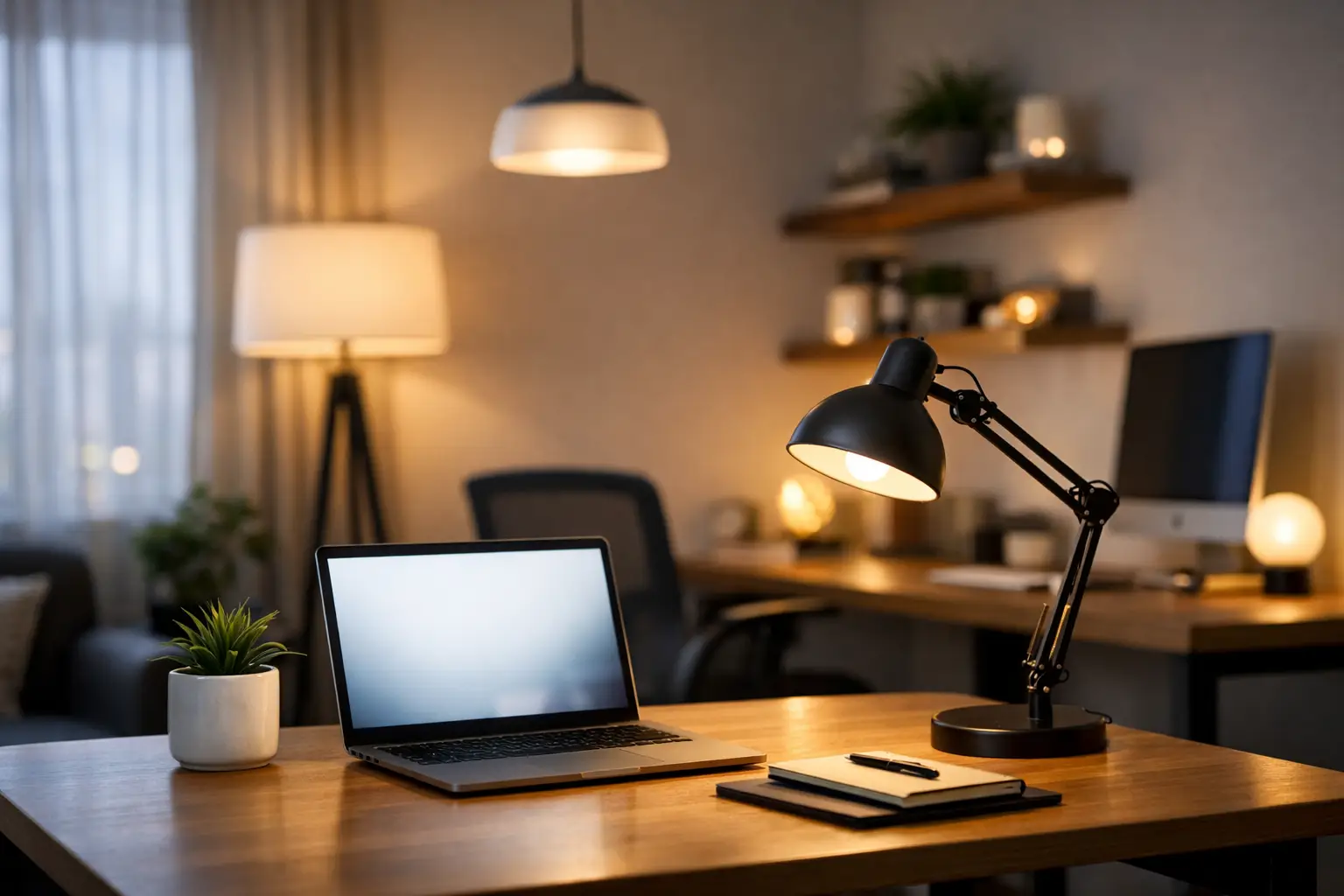
Your ceiling fitting or a floor lamp can provide general illumination. A desk lamp handles close work such as reading, writing and keyboard tasks. A small lamp behind or beside the monitor can lift the brightness of the wall or area around the screen. This reduces the stark contrast between a bright display and a dark room.
You do not need elaborate fittings. In many home offices, one decent desk lamp and a warm, low-level lamp elsewhere in the room make a noticeable difference.
Match brightness to the task and the time of day
For concentrated daytime work, your desk needs to be bright enough that you can read printed text without leaning in or straining. Yet brighter is not always better. If the lamp throws a hard pool of light onto white paper, reflects off a glossy desk, or makes the monitor look dull by comparison, turn it down or move it.
An adjustable lamp is useful because the right level changes through the day and with the weather. On a grey winter morning, you may need more help than on a clear June afternoon. Dimmable bulbs make this easier, but a lamp with a movable head can achieve much the same result by changing distance and direction.
A practical test is simple: after 20 minutes at your desk, notice whether you are squinting, rubbing your eyes or getting a tension headache. These signs do not prove lighting is the cause, but they are a good reason to adjust it before buying another gadget.
Choose a sensible colour temperature
Bulbs are commonly described by colour temperature, measured in kelvin (K). Lower numbers look warmer and more yellow. Higher numbers look cooler and whiter. For a home office used mostly in daylight hours, neutral to cool-white light is generally easier for detail work than a very warm bulb.
A useful range for a desk lamp is often around 4,000K to 5,000K. It looks clear without feeling as clinical as the bluest office lighting. For general room light, around 3,000K to 4,000K is often more comfortable, especially if the room is used for other purposes.
There is a trade-off. Very cool, bright light late in the evening can make it harder to shift into a calmer routine, particularly if you are already prone to poor sleep. If you work after dark, use sufficient light to see properly, but dim it and choose warmer tones once the focused part of the day is over.
Position the desk lamp to avoid glare
The best home office lighting ideas can fail if the light source is pointed straight at your face or screen. Place a desk lamp slightly to the side of your working area, with the light aimed down at the desk rather than across it. Keep the bulb or bright LED element out of your direct line of sight.
If you wear glasses, overhead lights and bare bulbs can reflect in the lenses. A shaded lamp, diffused bulb or lamp with an opaque head is usually more comfortable than an exposed filament-style bulb. Attractive lighting is fine, but comfort comes first when you are using it for hours.
Look at your monitor when the lamp is on. If you can see a bright reflection, alter the angle of the lamp, screen or both. Small changes in position are often more effective than changing the bulb.
Give your screen some surroundings
Working in a dark room with only a bright monitor can feel intense, even if the screen itself is set correctly. Your eyes repeatedly adapt between the illuminated display and the dark space around it. A low, indirect light behind the screen or on the wall behind it can soften that contrast.
This is sometimes called bias lighting, but the principle is straightforward: do not make the screen the only light in the room. Keep the background light gentle. It should not shine into your eyes or reflect on the display.
Avoid using colourful LED strips as your main working light. They may add atmosphere, but blue, purple or red lighting makes it harder to judge documents, skin tone and colours accurately. Save novelty lighting for after work, if you enjoy it.
Treat video calls as a separate lighting job
On video calls, the clearest light usually comes from in front of you and slightly above eye level. A window facing you works well if it is not too bright. If it is behind you, your camera will often expose for the window and leave your face in shadow.
A small diffused lamp behind your monitor can help on darker days. It does not need to be a dedicated ring light. The goal is soft, even illumination, not a dramatic studio effect. Keep it dim enough that it remains comfortable to look towards the screen.
Make evening work the exception where possible
If your working day regularly runs into the evening, lighting becomes part of your wind-down strategy. Bright, cool office lighting sends a different signal from the softer, warmer light most people associate with home and rest. That does not mean you must work in near-darkness. It means separating “I need to finish this task” light from “the day is ending” light.
Where possible, finish focused screen work earlier, then switch off the desk lamp and use lower, warmer room lighting. If you must continue, avoid a large, bright ceiling light and keep your screen brightness in proportion to the room. This is especially worthwhile if you tend to go from laptop straight to bed.
Do not ignore the rest of the room
Dark walls, high-gloss desks and whiteboards can all affect how lighting feels. A black desk can make a lamp seem harsher because the immediate area around your papers is so dark. Glossy surfaces can create reflected hotspots. Pale matte finishes tend to spread light more gently, but replacing furniture is rarely necessary.
Try the low-cost fixes first: move the lamp, add a shade, close a blind, reposition the monitor or place a light-coloured desk mat beneath papers. Keep the desk clear enough that light can reach the work surface. A pile of cables and folders creates its own shadows.
A simple home office lighting set-up
For most people, a reliable set-up is a desk beside a window, positioned at right angles to it. Add an adjustable desk lamp with a neutral-white bulb for darker hours, plus a softer lamp elsewhere in the room to prevent the monitor from dominating a dark background. Use blinds or curtains to control direct sun, and reduce the brightness and warmth of your lighting as the evening approaches.
Give the arrangement a week before judging it. Notice how your eyes feel after a normal working day, whether afternoon focus improves, and whether it is easier to switch off after work. No hype. Just a few practical changes that let your workspace support your energy rather than quietly drain it.
Further Reading
If you enjoyed this article you might like to read these articles.
- A Practical Afternoon Slump Fix That Lasts
- The Real Guide to Daily Energy
- Morning Sunlight Benefits for Energy and Sleep
The role of wellness products

Some people explore supplements or wellness products to support their daily routines. While these can sometimes be helpful, they should be viewed as support rather than a replacement for healthy habits.
If you are interested in exploring wellness products that may support energy routines, you can browse the options available at the Wellthy Freedom Hub store.
Always read ingredient labels carefully and speak with a healthcare professional if you have medical conditions or take medication.
Disclosure: This site may link to products on wellthyfreedomhub.com. If you choose to buy, the store benefits. The guidance here is informational and not medical advice.

Richard Chambers is the founder of rrjchambers.com. He writes about practical ways to improve everyday health, energy, and wellbeing through simple routines, lifestyle habits, and carefully chosen wellness products. His focus is on clear, honest guidance that helps people make small changes that support better health over time.
Health Information Notice
The information in this article is intended for general educational purposes only and should not be considered medical advice. If you have concerns about your health, sleep, or energy levels, it is always best to consult a qualified healthcare professional.