
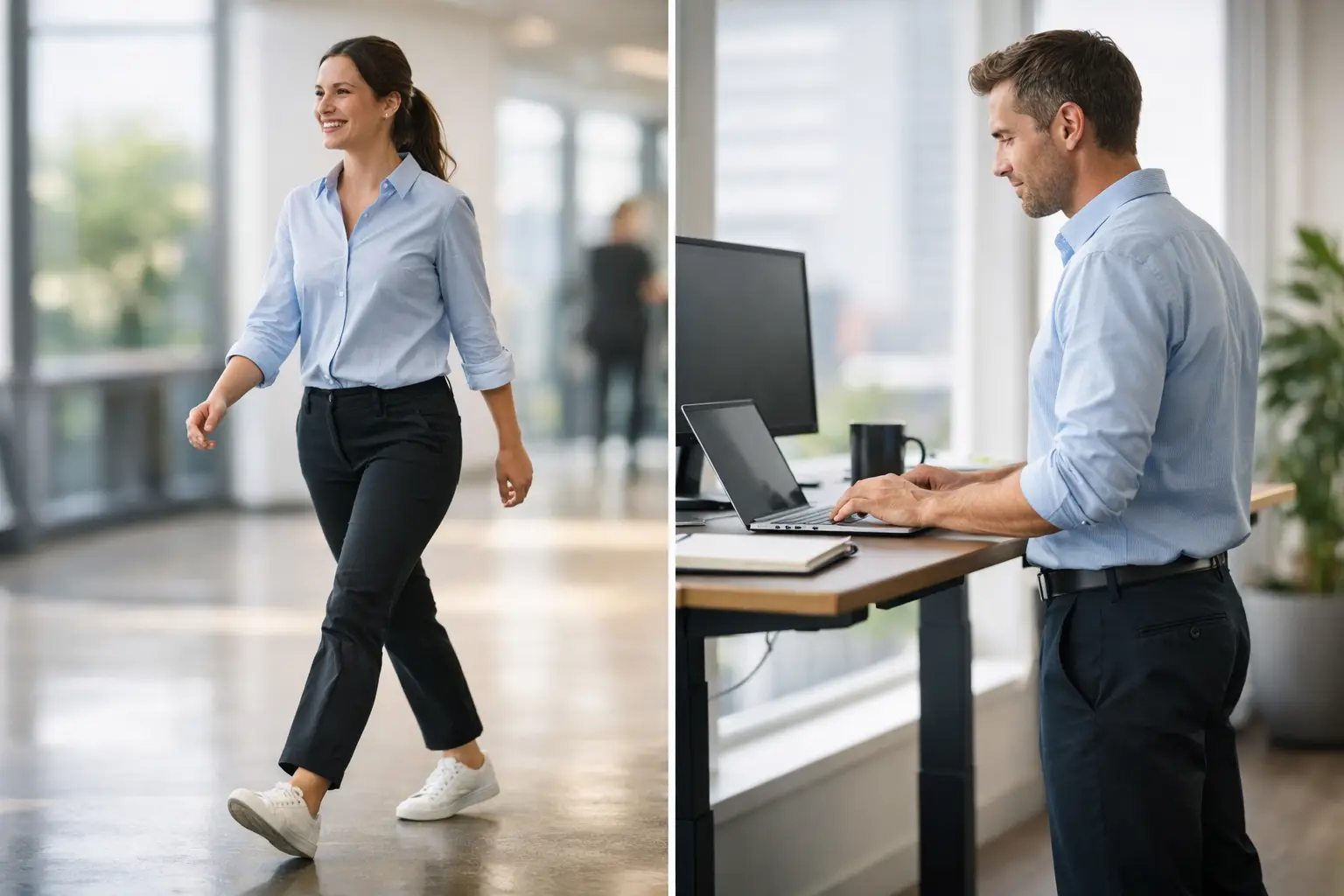
Walking Breaks vs Standing Desk: What Helps More?
By 3pm, many people do not need another coffee. They need to stop being still. If you are weighing up walking breaks vs standing desk for better energy and less stiffness, the useful answer is not that one is always better. They solve slightly different problems, and most desk-based workers benefit most from using both in a realistic way.
A standing desk can reduce the amount of time you spend sitting. Walking breaks add movement, change your posture and give your mind a short reset. Neither turns a tiring workday into a perfect one, but each can make the afternoon feel noticeably more manageable when used consistently.
Walking breaks vs standing desk: the key difference
A standing desk changes where you work. You are still answering emails, joining calls or concentrating on a task, but you are doing it upright rather than seated. This can be helpful if long periods in a chair leave your back, hips or legs feeling stiff.
Walking breaks change what your body is doing altogether. Even a brief walk to fill a water bottle, go outside, use the stairs or walk around the house interrupts prolonged stillness. Your muscles work differently, circulation increases and your eyes get a break from the screen.
That distinction matters. Standing is not the same as moving. It is generally better than sitting in exactly the same position for hours, but standing still for a long time can also cause sore feet, aching legs and lower-back discomfort. A desk that allows you to alternate positions is useful. It is not a reason to remain upright all day.
Walking, meanwhile, is more active but harder to fit around concentrated work, customer calls and family responsibilities. The best choice depends on what your working day actually permits, rather than what looks ideal on social media.
Why walking breaks often help energy more
When your attention starts to drift, a short walk can be more effective than trying to force another half-hour of focused work. It gives your body a change of pace and can help break the sluggish, heavy feeling that builds after sitting through meetings or working at a laptop without pause.
The benefit is not magic. You are not “boosting” your energy in a dramatic sense. You are reducing one common contributor to feeling flat: staying in one position, in one room, with one task for too long. A few minutes away from your chair can also make it easier to return to work with a clearer head.
For many people, walking outside is especially useful because daylight and a change of surroundings provide an additional cue that the workday is moving forward. This can be valuable for home workers whose commute has disappeared and whose days can otherwise blur together.
You do not need a 30-minute walk every time. Two to five minutes is enough to interrupt an extended sitting spell. A ten-minute walk at lunch is worthwhile if you can manage it, but it should not become another wellbeing task you feel guilty about missing.
Practical walking-break ideas
Attach breaks to moments that already happen. Walk while the kettle boils. Take a lap around the building after a video meeting. Put washing away between tasks if you work from home. If you are on a phone call that does not require notes or a screen, take it standing or walking safely.
The aim is not to hit a perfect number of steps. It is to make movement ordinary enough that it happens on busy days as well as quiet ones.
Where a standing desk earns its place
A standing desk is most useful when it makes position changes easier. If your work involves long stretches of reading, writing, calls or administrative tasks, moving from sitting to standing can relieve the sense that your body has become locked into the chair.
It may also help with alertness during lower-intensity work. Standing while sorting emails, planning the day, listening to a meeting or making calls can feel more engaging than sitting, particularly in the late morning or early afternoon.
However, standing desks are often oversold as a complete health solution. Buying one does not automatically improve your wellbeing, posture or energy. If it encourages you to stand rigidly in one position for three hours, it may simply replace one form of discomfort with another.
Set the desk at a comfortable height, keep the screen near eye level and use supportive footwear if you stand on a hard floor. More importantly, switch position before discomfort forces you to. Some people prefer 20 to 30 minutes standing at a time; others find shorter periods more comfortable. There is no prize for standing longest.
A cheaper option can work too. If a sit-stand desk is not practical, use a high kitchen counter for a short call or place your laptop on a stable raised surface for occasional standing tasks. Take care with screen height and avoid improvising a setup that leaves you hunched over.
The trade-offs people miss
Walking breaks are usually the stronger choice for breaking up inactivity, but they require a little more planning and may not suit every work setting. If you work in a busy office, on a reception desk or in a role with tightly timed tasks, frequent walks may feel unrealistic. Short trips to get water, use the stairs or speak to a colleague in person can still add up.
Standing desks are convenient because they keep you at your workstation. That makes them easier to use during calls and focused tasks. They can also be helpful for people who find sitting aggravates stiffness. But they cost money, take up space and are not always suitable if you have foot, joint or circulation issues that make prolonged standing uncomfortable.
Neither option replaces sleep, regular meals, hydration, daylight or enough movement outside working hours. If you are consistently exhausted despite reasonable habits, or fatigue is new, severe or affecting daily life, it is sensible to speak with a GP rather than assuming your desk setup is the whole answer.
A simple routine that works in a normal week
For most people, the most workable approach is to sit, stand and walk across the day rather than trying to choose one method. Start with what is easy to repeat.
Try beginning the morning seated for your most demanding work. Stand for a call or a routine task later in the morning. Take a brief walking break around lunchtime, ideally outdoors. In the afternoon, use another short standing period and a two- to five-minute walk when concentration starts to dip.
You do not need to watch the clock constantly. Use natural prompts: the end of a meeting, finishing a document, making tea, a toilet break or sending a batch of emails. If you tend to get absorbed and forget, a quiet reminder every hour can help, but do not treat it as an alarm you have failed if you are in the middle of something important.
The routine should fit your work, not compete with it. A parent working from home might walk while collecting the children from school or use household jobs as movement breaks. Someone in an office may take the long route to the kitchen or have one walking conversation with a colleague each day. Small changes count because they are easier to keep.
Which should you choose first?
If you are deciding where to put your effort or money, start with walking breaks. They cost nothing, add actual movement and can be adapted to almost any environment. Even people with a standing desk still need to move away from it regularly.
Choose a standing desk, or create more opportunities to stand, if sitting for long periods is a clear source of discomfort and your job keeps you tied to a screen. Think of it as a tool for variety, not a replacement for walking.
The most useful test is simple: notice how you feel after a week of making one change. Are you less stiff at the end of the day? Is the afternoon slump less intense? Can you concentrate for longer without feeling restless? Your own pattern is more useful than chasing someone else’s ideal routine.
A better working day rarely comes from one expensive purchase or a strict rule. It often comes from getting up a little more often, changing position before you ache, and giving your body regular reminders that it was built to move.
Further Reading
If you enjoyed this article you might like to read these articles.
- How to avoid post lunch sleepiness
- The Real Guide to Daily Energy
- Morning Sunlight Benefits for Energy and Sleep
The role of wellness products

Some people explore supplements or wellness products to support their daily routines. While these can sometimes be helpful, they should be viewed as support rather than a replacement for healthy habits.
If you are interested in exploring wellness products that may support energy routines, you can browse the options available at the Wellthy Freedom Hub store.
Always read ingredient labels carefully and speak with a healthcare professional if you have medical conditions or take medication.
Disclosure: This site may link to products on wellthyfreedomhub.com. If you choose to buy, the store benefits. The guidance here is informational and not medical advice.

Richard Chambers is the founder of rrjchambers.com. He writes about practical ways to improve everyday health, energy, and wellbeing through simple routines, lifestyle habits, and carefully chosen wellness products. His focus is on clear, honest guidance that helps people make small changes that support better health over time.
Health Information Notice
The information in this article is intended for general educational purposes only and should not be considered medical advice. If you have concerns about your health, sleep, or energy levels, it is always best to consult a qualified healthcare professional.