
Blackout Curtains vs Eye Mask: Which Helps?
This article contains affiliate links. If you buy through them I may earn a small commission at no extra cost to you.
If early summer sun is waking you at 4:45am, the question of blackout curtains vs eye mask stops being theoretical very quickly. Both can reduce light exposure and help protect sleep, but they solve the problem in different ways. One changes the room. The other changes what you wear. For most people, the better choice depends less on what sounds best and more on how you actually sleep.
Light matters because your body uses it as a timing signal. Bright light in the evening can delay sleepiness, while light in the morning helps tell your brain it is time to wake up. That is useful when you want to get up, but less helpful if a streetlamp, bright dawn, or a partner switching on a bedside lamp is cutting your sleep short. If you are tired during the day, making your bedroom darker is one of the more practical changes you can make.
Blackout curtains vs eye mask: the real difference
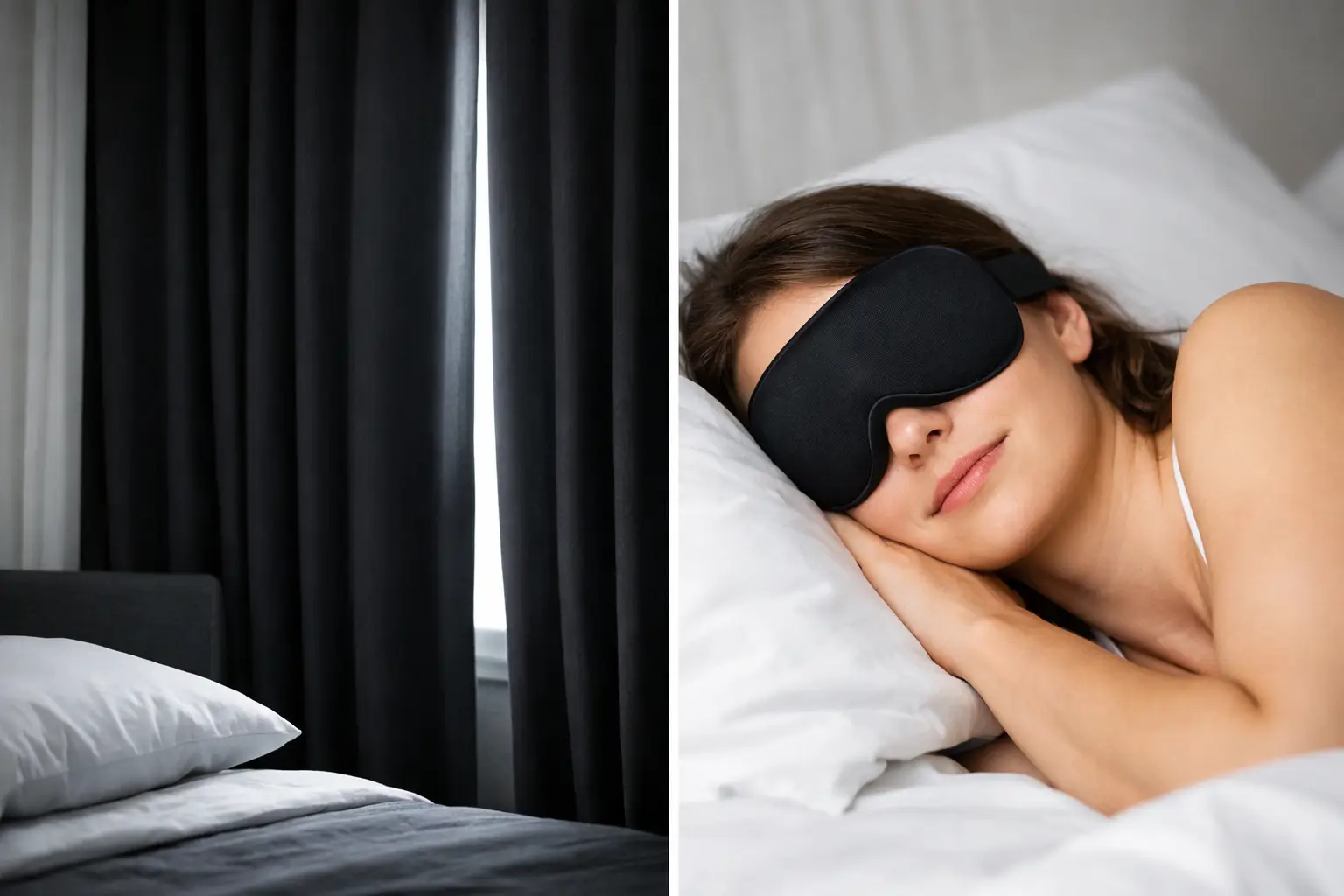
Blackout curtains block light at the window. Eye masks block light at your eyes. That sounds obvious, but it affects comfort, convenience, cost, and how reliable each option feels night after night.
Blackout curtains are a room-level fix. Once they are fitted properly, they work without much thought. You close them and the space is darker for anyone in the room. That can make them a good choice for people who dislike wearing anything on their face, share a bed, or want the whole bedroom to feel more sleep-friendly.
An eye mask is a personal fix. It travels with you, costs much less, and can work even when the room itself is not ideal. If you sleep away from home, work shifts, or cannot change your window coverings, an eye mask is often the fastest route to a darker sleep environment.
Neither is automatically better in every case. The useful question is what kind of problem you are trying to solve.
When blackout curtains make more sense
Blackout curtains usually win when the main issue is ambient light entering the room every night. That might be summer sunrise, a bright security light outside, or light pollution in a built-up area. If the room is consistently too bright, treating the window is often more effective than trying to cover your eyes and hoping the mask stays in place.
They can also help create a better wind-down environment before sleep. A darker bedroom in the evening can feel calmer and less stimulating, especially if outside light is strong. That does not mean blackout curtains are a cure for poor sleep on their own, but they can remove one source of disruption.
There are practical downsides. Good blackout curtains cost more than an eye mask, and fitting matters. Curtains that claim to be blackout can still leak a surprising amount of light around the edges, especially at the top and sides. In other words, the fabric may be effective while the setup is not. If your curtain pole sits far from the wall, or the curtains are too narrow for the window, you may still get light streaks across the room.
They are also less flexible. If you rent, travel often, or sleep in different locations, blackout curtains are not something you can easily take with you. And while they can slightly help with noise and temperature, people sometimes expect too much from them on those fronts.
When an eye mask is the better choice
An eye mask makes sense when you need targeted light blocking with minimal fuss. It is particularly useful for shift workers sleeping during the day, frequent travellers, people in rented accommodation, or anyone who wants a low-cost solution they can use immediately.
A good eye mask can block light very effectively, even in a bright room. In some cases, it does a better job than poorly fitted blackout curtains because it deals directly with the eyes. If your main problem is dawn light or occasional light disturbance rather than a room that is badly designed for sleep, a mask can be enough.
The catch is comfort. Some people forget they are wearing one within minutes. Others find masks irritating, too warm, too tight, or prone to slipping off. Side sleepers can struggle if the fit is bulky or presses awkwardly around the nose. If a mask feels annoying, it stops being a sleep aid and becomes one more thing to tolerate.
Fit matters far more than many people realise. A flimsy mask that lets in light around the nose or shifts every time you turn over will not do much. A better-designed mask with a soft strap and a shape that sits securely can make a major difference.
Blackout curtains vs eye mask for comfort and consistency
Comfort is where personal preference matters most. Blackout curtains are passive. Once installed, they do their job without touching you. For many people, that makes them easier to live with over the long term. If you are sensitive to pressure, heat, or fabric on your face, curtains are likely to be the more comfortable option.
Eye masks ask a bit more from you. They need to be put on every night, adjusted properly, and tolerated through the night. Some people adapt quickly. Others never do. If you already struggle to fall asleep, adding something that feels unfamiliar can be unhelpful.
Consistency matters because sleep improvements usually come from repeated habits, not one-off fixes. The best option is often the one you will actually use every night without resistance. A theoretically perfect solution is not much use if it stays in a drawer or never gets fitted.
Cost, practicality and value
If budget is a factor, eye masks are the obvious starting point. You can test whether darkness helps your sleep without spending much. That makes them a sensible first step, especially if you are not yet sure whether light is one of your main sleep problems.
Blackout curtains are more of an investment, but they can offer better value in a permanent bedroom setup. They work for years, benefit anyone using the room, and require less daily effort. For families, couples, or anyone setting up a bedroom properly, that broader usefulness can justify the cost.
There is also a middle ground here. Some people use blackout blinds or curtains as the main defence against outdoor light, then keep an eye mask for summer mornings, travel, or the occasional bright interruption. That is often the most realistic approach rather than treating it as an either-or decision.
What if your sleep problem is not really light?
This is the part people often skip. A darker room helps if light is genuinely disturbing your sleep. It will not do much for a late caffeine habit, irregular bedtimes, stress, alcohol, overheating, or too much screen time close to bed.
If you are constantly waking in the night, struggling to switch off, or dragging through the day despite enough time in bed, darkness may be only one piece of the picture. Practical sleep changes tend to work best in combination – a darker room, a cooler bedroom, a more regular sleep schedule, and less bright light in the hour before bed.
That is why RRJChambers tends to favour simple habit changes over miracle products. Sleep is often improved by removing a few obvious obstacles rather than searching for one perfect fix.
How to choose the right option for your situation
If your bedroom is bright every night and you want a set-and-forget solution, start with blackout curtains. If you travel, sleep during daylight hours, rent your home, or want the cheapest useful option, start with an eye mask.
If you hate anything touching your face, curtains are the safer bet. If you cannot install curtains or need something for multiple settings, an eye mask is more practical. And if you share a room with someone whose schedule or habits expose you to light, combining both may give you the most reliable result.
It is also worth paying attention to timing. If you want to wake naturally with daylight in winter but block very early sunrise in summer, an eye mask gives you seasonal flexibility. If outside light is a year-round problem, curtains are more likely to solve the root issue.
A sensible verdict on blackout curtains vs eye mask
For most people, blackout curtains are the better bedroom upgrade and eye masks are the better portable fix. Curtains usually win on comfort and ease once installed. Eye masks win on price, flexibility, and speed.
If you are unsure, test the cheaper option first. Use a decent eye mask for a week or two and pay attention to whether you fall asleep more easily, wake less, or feel more rested. If darkness clearly helps, you can then decide whether blackout curtains are worth adding for a more permanent setup.
Better sleep rarely comes from buying the fanciest thing. It usually comes from noticing what is disrupting you and fixing that as simply as possible. If light is one of those disruptions, the best choice is the one that makes darkness easy enough to stick with.
Recommended products on Amazon UK
Blackout curtains — best value
Deconovo Blackout Curtains are one of the most consistently top-selling blackout curtains on Amazon UK, with tens of thousands of reviews. They use a triple weave fabric that blocks 95–99% of light depending on colour chosen — darker colours perform better. Available in a wide range of sizes and colours, eyelet-topped for easy hanging, and machine washable. A solid practical choice if you want proper room darkening without spending heavily.
NICETOWN Thermal Blackout Curtains are a step up in fabric quality and thermal insulation. The triple weave construction helps with temperature regulation as well as light blocking — useful in the UK where bedrooms can get cold in winter or bright very early in summer. Available in multiple drop lengths to suit different window heights.
Blackout blind — alternative to curtains
If curtains do not suit your window or room style, a blackout roller blind can be a tidier solution. Look for one described as “total blackout” rather than just “room darkening” — the distinction matters if you are a light-sensitive sleeper. Measuring your window recess carefully before ordering will save a lot of frustration.
Sleep mask — best silk option
The Drowsy Silk Sleep Mask is a well-established UK brand available on Amazon UK. Made from 22 momme mulberry silk with a padded inner layer, it blocks light fully without pressing on the eyes and is gentle on the skin around the eye area. More expensive than foam alternatives but noticeably more comfortable for all-night wear – particularly useful if you find synthetic masks warm or irritating.
Sleep mask — best budget option
For a more affordable entry point, the Gritin 3D Contoured Sleep Mask is a well-reviewed UK option that uses a moulded shell to keep pressure off the eyelids. It does the job reliably for most people and costs a fraction of a silk mask — worth trying first if you have never used a sleep mask before and are not sure whether you will get on with wearing one.
Sleep mask — best for travel
If the main reason for considering a sleep mask is travel or hotel stays, the Manta Sleep Mask is compact enough to pack easily and adjustable enough to fit different face shapes. It maintains a proper light seal even when your head is pressed sideways against a seat or pillow — something flat masks consistently fail at.
Whether you choose curtains, a mask, or both, the aim is the same — a bedroom dark enough that your brain receives a clear signal that it is time to sleep. For most people in the UK, where summer mornings arrive well before 5am, having at least one of these in place makes a practical difference to sleep quality.
Further Reading
If you enjoyed this article you might like to read these articles.
- How to avoid post lunch sleepiness
- The Real Guide to Daily Energy
- How to Improve Sleep Quality Naturally
The role of wellness products
Some people explore supplements or wellness products to support their daily routines. While these can sometimes be helpful, they should be viewed as support rather than a replacement for healthy habits.
If you are interested in exploring wellness products that may support energy routines, you can browse the options available at the Wellthy Freedom Hub store.
Always read ingredient labels carefully and speak with a healthcare professional if you have medical conditions or take medication.
Disclosure: This site may link to products on wellthyfreedomhub.com. If you choose to buy, the store benefits. The guidance here is informational and not medical advice.

Richard Chambers is the founder of rrjchambers.com. He writes about practical ways to improve everyday health, energy, and wellbeing through simple routines, lifestyle habits, and carefully chosen wellness products. His focus is on clear, honest guidance that helps people make small changes that support better health over time.
Health Information Notice
The information in this article is intended for general educational purposes only and should not be considered medical advice. If you have concerns about your health, sleep, or energy levels, it is always best to consult a qualified healthcare professional.