
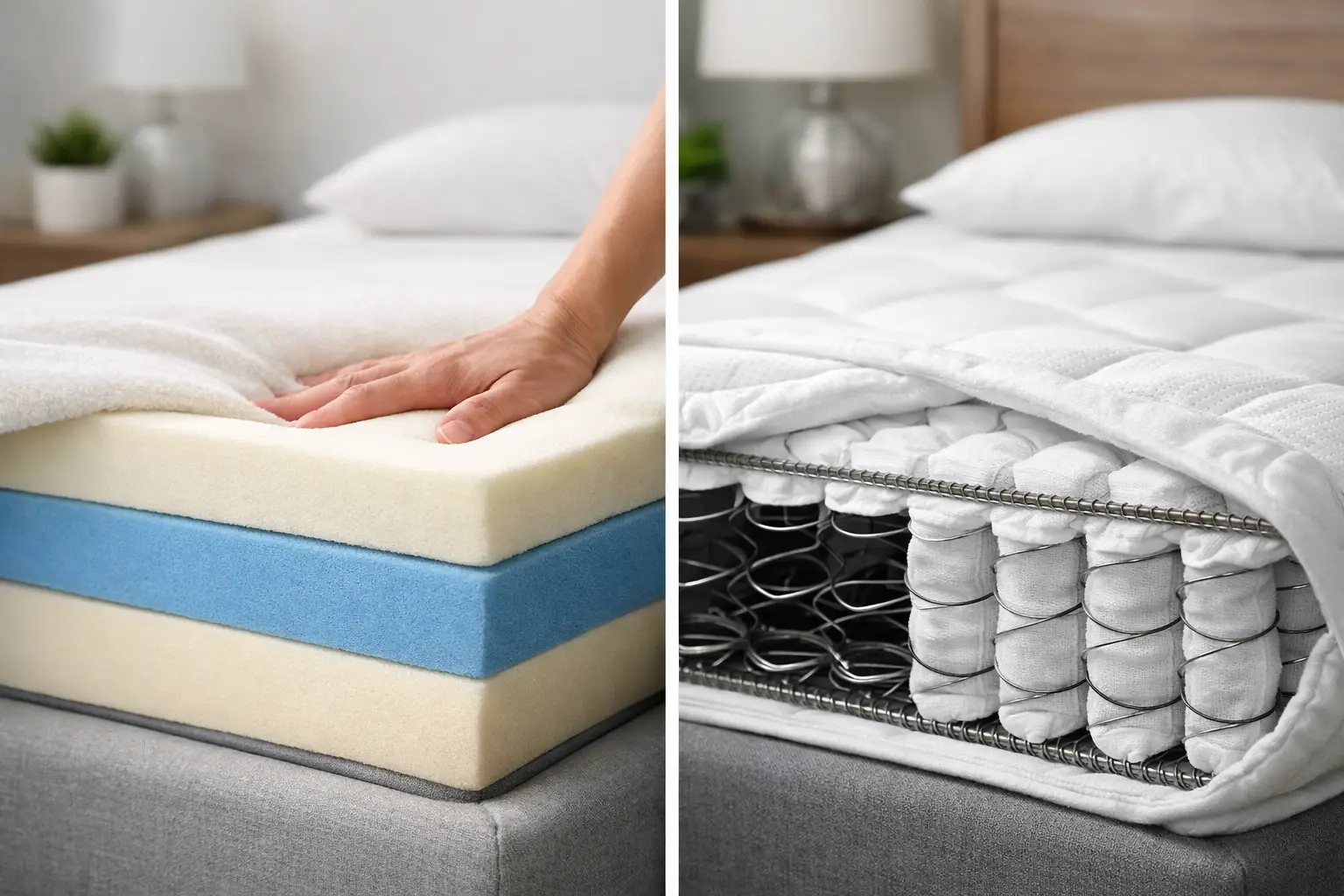
Foam Mattress vs Sprung Mattress Sleep
Table of Contents
This article contains affiliate links. If you buy through them I may earn a small commission at no extra cost to you.
If you wake up tired even after a full night in bed, your mattress may be part of the problem. The foam mattress vs sprung mattress sleep debate matters because the wrong surface can leave you overheating, aching, or restless without you fully realising why.
A mattress will not fix poor sleep habits on its own, but it does affect how well your body settles, stays comfortable and recovers overnight. For most people, the better option is not the one with the biggest marketing budget. It is the one that matches your sleep position, body weight, temperature and sensitivity to movement.
Foam mattress vs sprung mattress sleep: what is the real difference?
At a basic level, foam mattresses compress and contour around your body, while sprung mattresses use coils to provide support and a bit more bounce. That sounds simple enough, but the way each one feels at 2am is very different.
Foam tends to absorb movement and spread pressure more evenly. This can help if you sleep on your side, share a bed with a restless partner, or often wake with sore hips or shoulders. It usually feels more stable and less springy, which some people find calming.
Sprung mattresses, especially pocket sprung ones, tend to feel more responsive and breathable. They can be easier to move around on, which matters if you change position often in the night. Many people also find them cooler because air circulates more freely through the mattress.
Neither type is automatically better for sleep. The right choice depends on what is currently disturbing your rest.
If your sleep is light, pressure relief matters
A common reason for broken sleep is pressure build-up. If your mattress pushes too firmly against your shoulders, hips or lower back, your body keeps making small adjustments to get comfortable. You may not remember waking, but your sleep can still be fragmented.
This is where foam often does well. Memory foam and other high-density foams mould to the body and reduce pressure points. Research on sleep surfaces and spinal alignment has shown that medium-firm support often suits many adults best, though individual comfort still varies. The NHS also notes that staying in a comfortable sleeping position and reducing aches can support better rest.
If you are a side sleeper, foam can feel noticeably kinder on joints. Instead of your shoulder and hip taking the brunt of your body weight, the mattress spreads that load more evenly. For people dealing with general stiffness, this can mean fewer overnight disruptions.
That said, some foam mattresses feel too enveloping. If you dislike the feeling of sinking in, that same pressure relief can become a reason you sleep worse rather than better.
Foam can help if you wake with aches
People with mild back, hip or shoulder discomfort often assume they need a very hard mattress. In reality, mattresses that are too firm can create just as many problems as ones that are too soft. A good foam mattress can support the spine while still cushioning the body.
The key word is good. Cheap foam can lose shape quickly and create dips that put the spine in an awkward position. That is not supportive. It is simply soft in the wrong places.
If you overheat at night, sprung often has the edge
Temperature makes a bigger difference to sleep than many people think. According to the Sleep Foundation and guidance commonly echoed by UK sleep experts, a cooler sleep environment usually supports better sleep quality. If your mattress traps heat, you may drift off easily enough but wake in the early hours feeling too warm.
Traditional memory foam has a reputation for sleeping hot, and that reputation is not entirely unfair. Dense foam can hold onto body heat, particularly in a warm room or during summer. Newer foams with open-cell structures or cooling gels can help, but they do not always fully solve the issue.
Sprung mattresses usually allow more airflow, especially those with breathable natural fillings. If you are someone who throws the duvet off, wakes clammy, or prefers a fresh, cool bed, a sprung mattress may suit you better.
This matters even more if your bedroom already runs warm, you sleep in thick bedding, or you are going through hormonal changes that affect body temperature. In those cases, choosing a heat-retaining mattress can make a tiredness problem worse.
If your partner gets up early, fidgets, or rolls over frequently, your mattress should reduce that disturbance rather than amplify it. Foam tends to perform better here because it absorbs movement. One person turning over is less likely to send a ripple across the whole bed.
A traditional open coil sprung mattress often transfers more motion. Pocket sprung mattresses are better because each spring moves more independently, but they still tend to have more bounce than foam.
For couples, this is one of the clearest differences in foam mattress vs sprung mattress sleep. If one of you sleeps lightly and the other moves a lot, foam is often the more restful option. If neither of you is disturbed by movement and you both prefer a buoyant feel, sprung may still be the better fit.
Which suits your sleep position?
Your usual sleep position changes what good support feels like. Side sleepers often prefer foam because it cushions pressure points. Back sleepers can do well on either foam or sprung, as long as the mattress keeps the spine in a neutral position. Front sleepers usually need to be more careful with softer foam, because too much sink around the hips can strain the lower back.
Body weight also matters. Lighter people may find firm sprung mattresses too unyielding, while heavier people may prefer the stronger support and easier movement of a well-made sprung or hybrid design. This is why mattress reviews can be so contradictory. Two people can try the same bed and have completely different nights on it.
Hybrids sit in the middle
If you like the idea of pressure relief but worry about heat or feeling stuck, a hybrid mattress is often worth considering. These combine springs with a foam comfort layer, aiming to give you contouring without the full sink of all-foam.
They are not a magic answer, but for many adults they offer a sensible middle ground. At RRJChambers, that is usually the practical answer worth paying attention to – not the extreme option, but the one that solves the main problem with the fewest drawbacks.
Durability, maintenance and what affects long-term sleep
A mattress that feels fine in the showroom can become a problem after a year if it starts sagging. Once support breaks down, sleep quality usually follows. You may wake stiff, toss more, or feel as if you are rolling into the centre.
High-quality sprung mattresses can last very well, particularly pocket sprung models with decent fillings. Foam mattresses can also be durable, but density matters. Low-density foam tends to soften faster and lose support sooner.
There is also the practical side. Some foam mattresses are heavy and awkward to turn or move. Some sprung mattresses need regular rotating to wear evenly. Neither issue is dramatic, but it is worth thinking about if you are buying for a spare room, carrying it upstairs, or managing the bed on your own.
How to choose based on the sleep problem you actually have
If your main issue is joint pressure, partner movement or feeling every spring beneath you, foam is often the better place to start. If your main issue is overheating, struggling to turn in bed, or wanting a more traditional supportive feel, sprung usually makes more sense.
If your sleep is poor for several reasons at once, be honest about which one affects you most. A mattress can help with comfort, temperature and movement, but it will not correct a late caffeine habit, stress, inconsistent bedtimes or a bedroom full of light. The best results usually come when your mattress supports the other simple habits that improve sleep.
A sensible test is this: when you wake in the night, what is bothering you? If the answer is heat, trapped feeling, or difficulty moving, lean towards sprung. If the answer is numb shoulders, sore hips, or being woken by someone else turning over, lean towards foam.
There is no perfect mattress type for everyone, only a better match for your body and your nights. If sleep has felt patchy for a while, changing your mattress may not be glamorous, but it can be one of the more useful fixes because you feel the difference every single night.
A few specific mattresses worth looking at
If you have read this far and think foam sounds like the better fit, the Emma Original Mattress is a sensible place to start. It is a well-established UK brand with a reasonable balance of contouring and support, and it ships compressed in a box, which matters if you are setting it up without help. Ready Steady Bed also stock a range of foam mattresses worth comparing prices against before deciding.
Sprung – for those who sleep warm
For a traditional pocket sprung feel, Silentnight pocket sprung mattresses are widely available and well reviewed, with good airflow that suits anyone who tends to overheat at night.
Hybrid – the middle ground mentioned in the article
If a hybrid sounds like the right compromise, Simba Hybrid mattresses are one of the more consistently recommended options in this category, combining pocket springs with a foam comfort layer. They tend to sit at a higher price point than either pure foam or pure sprung options, but for people who cannot decide between the two, it removes the need to choose.
A note on trial periods
Most mattress brands now offer a trial period of 60 to 100 nights, which matters more than almost anything else when buying online without lying on it first. Always check the actual trial length and return process before buying rather than assuming, as policies vary considerably between brands.
Prices and specific models change often, so it is worth comparing current listings on Amazon UK before deciding. The right mattress is the one that solves the specific problem keeping you up at night, not necessarily the most expensive one.
Further Reading
If you enjoyed this article you might like to read these articles.
- How to avoid post lunch sleepiness
- The Real Guide to Daily Energy
- How to Improve Sleep Quality Naturally
The role of wellness products

Some people explore supplements or wellness products to support their daily routines. While these can sometimes be helpful, they should be viewed as support rather than a replacement for healthy habits.
If you are interested in exploring wellness products that may support energy routines, you can browse the options available at the Wellthy Freedom Hub store.
Always read ingredient labels carefully and speak with a healthcare professional if you have medical conditions or take medication.
Disclosure: This site may link to products on wellthyfreedomhub.com. If you choose to buy, the store benefits. The guidance here is informational and not medical advice.

Richard Chambers is the founder of rrjchambers.com. He writes about practical ways to improve everyday health, energy, and wellbeing through simple routines, lifestyle habits, and carefully chosen wellness products. His focus is on clear, honest guidance that helps people make small changes that support better health over time.
Health Information Notice
The information in this article is intended for general educational purposes only and should not be considered medical advice. If you have concerns about your health, sleep, or energy levels, it is always best to consult a qualified healthcare professional.